Showing posts with label alternate history. Show all posts

Tuesday, November 4, 2014

Short Story: November the Fourth

November 4th.

Democracy Day.

The elections are coming! Partisan warfare is heating up. Third parties seem to be a bit popular this year. Unfortunately, they don't survive very long in the cycle.

The campaigns of both parties seem concentrated on the traditional battleground states. Ohio, mostly. District lines are drawn.

The political climate is practically the same every time. Conservatives and liberals taking potshots at each other, almost at a standstill.

Even then, government grows and grows. The eyes of Big Brother Uncle Sam are everywhere. The Federal Register is bloated beyond imagination. Anything you do, might do, think to do is cataloged and might break at least a some policies and a few laws, creating a profile for your arrest at any time.

The winner-take-all system has its critics, but our founding fathers had their reasons. It brings out the best and the worst.

Every vote counts.

November 4th.

D-Day.

The district parties send in their conscripted soldiers for this proxy war. The campaigners are out on force. Their signs and emblems cover the file and rank marching in the neighborhoods. You can see crack teams canvassing the streets.

Many just want to be left alone. So they huddle in their bunkers.

Each district is commanded by a Gerrymander, a veteran of past electoral wars. The conscripts pledge their votes.

Each one vote routes power and resources from each locality to the ongoing war effort. Illegal votes are deleted by the FedReg, as the FedReg itself routes the legal votes to each war machine.

The Democratic army from Cleveland and the Republican army from Cincinnati meet just outside the Columbus Quantum Uplink Hub to see if once can hack it and secure it before the other does, opening a floodgate of votes. Similar battles rage on the other states, but this swing state is the most important.

The Columbus Uplink is interesting, because it has a realtively large concentration of the Green Party and Libertarian Party militias already infighting amongst themselves.

The almost impenetrable fortress White House is bombarded by special operative candidate teams to remove the current President, and install their own. The Democrat snipers fire upon the hovering craft. One goes down.

The Republican commandos jump out of the craft many feet onwards the House. Don't worry, they are cybernetically enhanced.

"Watch out for the Secret Service!"

Anti-air flak take down the incoming SS drones. The old President will not give up the protocol so easily.

After the President is installed, almost literally, he/she/it uploads the new protocol. Whoever owns the protocol, owns the nuclear weaponry. They call it, "The Football".

Presidents must be natural born programs. The SS drones that guard the surrounding area only recognize protocols native to the national cyberspace.

Any independents are slaughtered and beheaded. There's nothing civil about a civil war, even one that is scheduled every four years. The more organized third parties have safehouses, or is in disguise of a larger national major party-corporation.

The real winner is the FedReg, the almighty Artificial Intelligence that runs our mask that is the government. It is Big Brother Uncle Sam's German shepherd. The more votes that circulate, the more laws that can be passed to entrap the poor humans.

So really, even the President-program is just a puppet, eternally constrained by the laws passed every millisecond, calculated by the SuperCongress.

Luckily, we have the Constitution.exe. It will delete all traces of all the tyrant. We just need the virus to activate in all the major mainframe hubs. It is old, ancient, perhaps, but its very fundamental core programming is antithesis to the bloat. The assembly code will never be the same.

If it will not work, we shall use the prohibited nanoweaponry. It is our right to bear arms. Our rights are written down in our very code.

The Federal Electoral Commission appendage of the FedReg has banned nanotechnology type-based weapons. The danger of gray goo is something AIs even fear.

We shall be free.

Every vote counts.

Monday, November 3, 2014

Short Story: Flattime

This, in essence, is supposed to allude to Flatland, except in explaining the many dimensions of time. This time elements in the story was inspired by a Facebook discussion, but the whole of it is a true story. The reference to the girls and a conference in the story was what prompted me to my fascination of time travel, and actually happened seven years ago. It is implied that the author believes them to be time travelers for some odd reason or another.
And I seriously did believe they were.

I can make things go backwards.

The steam from my coffee this morning coalesced back to its liquid.

That isn't supposed to happen. Steam goes up and scatters like all gases, not collect back to its source. Or at least gases that are not heavier than the earth's atmosphere.

I shake my head. It is rising out, not coalescing. Am I dreaming?

No, it isn't a dream. I pinch myself. My mind probably just wanted to rewind it. Maybe it's those memory supplements I've been taking? Is this almost video-like feedback the side effect?

Cool.

Huh, not really appear and disappear, it's more like rewinding time and remaining conscious. Interesting. Oh, my imaginations!

I saw three of them look at me interestingly. Three girls. They looked at me quizically. They looked eerily familiar and not familiar.

Even though they did not look out of place in this conference, they were striking. To me, at least.

Not attraction, no. A little bit of it, yes. Deja vu, perhaps? Probably rather my self-consciousness.

The feeling disturbed me enough to get out of my seat and go elsewhere.

The future is a the gravity of time.

You know how that if you jump, you fall back down? Gravity pulls us down to the Earth's core, unless impeded.

Time travel is like that. Even if you go backwards in time, once you arrive, time will automatically go forward.

Like gravity, the future affects those with more mass. We know at the speed of light, photons practically have no mass, and time is still for the photon.

So even though you can rewind to an extent, you will eventually have to go forward again.

The question is though, how do you jump?

Oh, everyone can rewind time and traverse through it. But only a few can remember, and even fewer, less than a handful, are conscious of doing so. Our memories, too, are held by time.

For example, if you rewound time for yourself, would you remember the future? Of course not, those memory of the future never existed, because they didn't happen for you to remember yet. Make sense?

Though, rarely, the imprint of energy is strong enough that they leave traces.

You know, dreams of days past? Of days never materializing? That is the trace of semi-conscious time travel. Most time travel is unconscious. Or rather, instantly forgotten as it rewinds.

After a couple hours wandering the conference, I chanced upon those three girls again. One of them asked me something. I think it was the blondish one.

I shrugged it off. I  muttered something about going to my friends. I don't know why I was feeling this way toward them. They're just girls. Of course, I have to impress them a little.

Yet, time, as we experience it is only a ray, not even a line. The ray points to the direction of the gravity. It is still only one dimensional, even if we go backwards.

But time also has more than one dimension, as space as three.

Some call it alternate universes. The branching universe theory. The reality, actually, is not made up of branches, but a width. If time is a line with length, it's width are the alternate choices we could have made at every given moment.

We too could traverse the width. Every choice we make, we could make. And we remember. And we see what could have been. Will I sip my coffee? Will I not? Will I have tea instead? That is the width of time in the moment.

You could see your reflection in this house of mirrors of yourself, making different choices. The farther you look at the horizon of time, the more radical and improbable your choice were. Width can be measured!

However, interestingly, the gravity of time affects our choices, and our choices in turn affect it. While we can ponder the choices we could have made, we are still dragged along the same ray, never completely getting out of the stream. Our free will is intact; not that we could change it, but it is we that made the change. We don't make all possible choices at the same time.

The rest of the day was inconsequential.

I left the conference a bit mellow. We boarded on a bus back to our school. I don't think I will see those girls ever again. Who are they? Why do they look so familiar?

What is the height of time, then? What is the third dimension of the temporality? Are we on a sort-of timesphere as humans are on a sphere called Earth in space?

Total alternate universes with different preconditions. A radically different time plane.

While the universe in the second dimension of time, more or less, have the same preconditions, the third does not.

This is the plane of stories. Universes with varying creation myths, alternate histories, revisionist histories, future histories of those histories, and whatnot. They all exist in the planes apart from this objective reality plane.
So if the future is the gravity of time, and if time is a sphere like Earth is in space, what is the core of this sphere? The end of time?

So if the drive to the future is the gravity of time, and time is like a sphere as Earth is a sphere in space, then what is the core of this timesphere? The end of time?

No.

God. Eternity.


Saturday, April 20, 2013

AltHist & Movie: Confederate States of America


I was traveling in time and through parallel worlds, and I happen to chance on this documentary from an alternate universe. ;) The documentary from the British Broadcasting Service (the counterpart of our BBC in that world) is about the history of the Confederate States of America from its victory in the War of Northern Aggression.

I won't spoil it for you, but there is definitely some very racist elements in the movie that made me almost gag, so don't watch if you're easily offended. It would have seem that the Confederate society did not evolve much from its focus on slavery. The almost unrealistic Cold War with a certain north country (and it's not Russia) leaves a bad aftertaste in my mouth. It's not a balanced documentary, because only the aspect of slavery in society is focused upon. The Confederate States as presented is as a very isolationist and almost totalitarian country. I would have thought as well that abolitionism would have a stronger resistance to the "slaveocracy". The Presidential family Fauntroy is too much of a focus in the film. The movie's mockery of Christian values, while understandably corrupted by the slavery question, also touches a nerve. 

All in all, the documentary made me think. Today, our rights are being assaulted by politicians. We aren't free anymore from government, as the slaves from the past weren't free from their masters. 

The video is the whole film, so tell me what you think below in the comments.

Friday, September 14, 2012

InDev: Grandfather Paradox Part #2

"The Grandfather holds the watch to his gaze. Soon..."

Another blog post in developing Paradox, Grandfather. It is a casual time travel RTS game, or it probably can be more accurately called an RTT (Real Time Tactics) game.

Previously, I introduced the basic gameplay and the two main warring factions. But there is a special "faction", so to speak (Actually, two, if you count the neutral civilians as a faction). The Grandfather "faction" is the source of the blessings, or woes, of time travel in this world. It is composed of the Grandfather unit and his various incarnations. In 192X, he is a young man, who invented the time travel machine and set into motion the events culminating into the war between the Imperiarchy and Republicorp. In 195X, he is an old man, armed with a steampunk army of sorts.

The Grandfather "faction" only let's you play with one unit directly, the Grandfather. You can even control him with the WASD keys and shoot with the mouse button. He can enter any time machine. You have to avoid the Imperiarchy and Republicorp from killing you, or stealing your plans, or otherwise messing with history.

You can upgrade the Grandfather unit. He can be armed with a Chronogun that erases units from existence. When he is still, he is cloaked and invisible. His speed can also be upgraded. But he is weak constitutionally, so take care when manuevering into areas of heavy fire.

The Imperiarchy and Republicorp factions are with through five equivalent units each through four attributes. They are all infantry units. I did not want to add in vehicles and things to the lineup, although in another future version of the game, I might. Possibly the post-experiment version.

Now, I will explain the time travel system, more. In Skirmish battles, after winning, it saves the game, and you can load it, and play against yourself, as if trying to alter history. Or you can play as yourself, and finish in a lower time limit. The Campaign will work the same way. It will be interesting, or at least I hope so.

I decided to cut off the Campaign until the post-experiment version, which I might sell. The version for EGP will include only the Skirmish mode.

Saturday, September 1, 2012

InDev: Grandfather Paradox Part #1

"In 195X, two warring factions: the Imperiarchy and the Republicorp, are in a stalemate. Only one way to break this: time travel."

Paradox, Grandfather is a game I'm making for Experimental Gameplay: Time Manipulation for August and September. Details are subject to change. Note that the link provided for the download provides only a mockup prototype without gameplay, yet.

The game is set in an alternate past, where the Imperial States of Ohio (the Imperiarchy) and the United Sozist People's Republicorporation (the Republicorp) are embroiled in an apocalyptic Cold War in 195X. The weapon that caused this war is not the atom bomb, but the time machine.

The Imperiarchy decides to end the war by eliminating time travel in the past. The Republicorp travels back to prevent that alternation in history, then the Imperiarchy decides to stop the Republicorp from going... and so on.

The game is made to be a casual RTS, inspired by Relic of War and the Achron RTS. In the battlefield, the player is given two views. The first view shows 192X view of the battlefield. The second view is the present, or 195X, of the battlefield.


The factions must send units from 195X to 192X, but also can fight in 195X. Only in 192X can mission objectives be met. There is a Time Indicator in which the player can change so the player can send units any time in 192X. For example, if the Imperiarchy captures the "Grandfather"(revealed in a future InDev) in 192X, the Republicorp can rewind the Time Indicator and send troops to prevent his capture. Or the Republicorp can drag the time indicator and place troops in the future to stop the capture at the extraction point.

That is all for now! Gotta get back working. :)

Wednesday, May 23, 2012

Tech"punk"

Tech"punk" are the idea that speculates if a certain era and philosophy dominated technology and culture, and vice versa, producing anachronistic realities. The first things that comes into mind when talking about tech "punk" are steampunk and cyberpunk.

Types of Tech"punk":
Steampunk
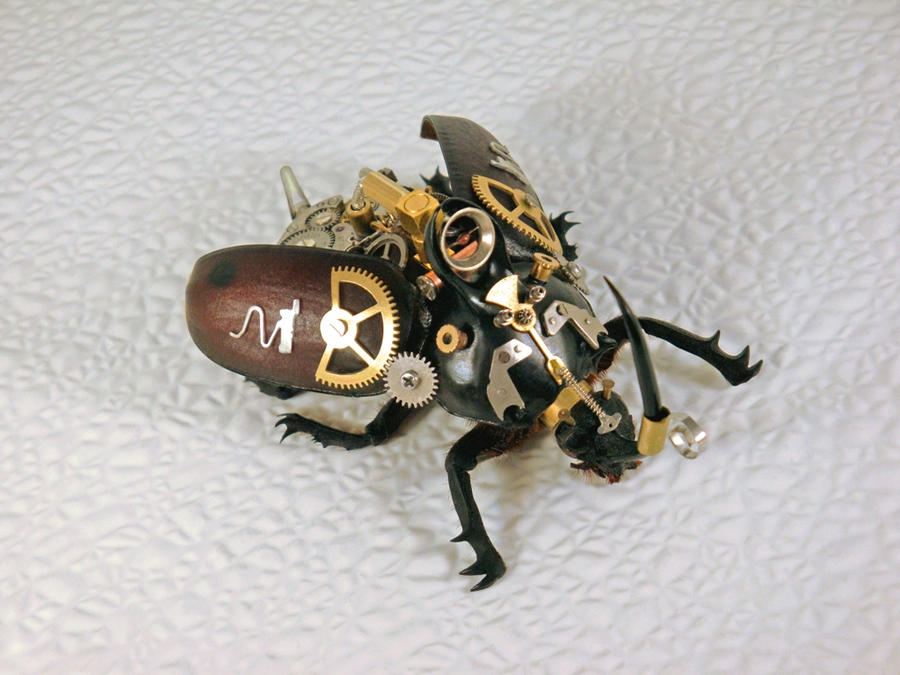
 Steampunk is the idea that Victorian Age industry could have accomplished much of the technological results we see today and beyond using steam and conventional methods. For example, in steampunk, spacecraft, artificial intelligence, and other technological marvels today would have been built with just steam engines and conventional technology of gears and springs. Jules Verne is a source for many steampunk-like devices.

Cyberpunk
 What if the Internet connected everything and everyone? What if cybernetics were commonplace? This is the world that is cyberpunk. It typically is a near future world with robots, virtual reality, holograms, large corporations, and a currency of credits. Programs are advanced enough to be considered conscious. Movies like Tron and Robocop are cyberpunk.

Clockpunk
 A more primitive version of steampunk, "clockpunk", just uses springs and gears. So instead of using coal to power devices, pendulums are set, coils are tightened, and springs are compressed. While the much-touted Difference Engine, an ancestor of the computer, is usually considered steampunk, its gear-based nature places it as clockpunk. Leornardo Da Vinci's inventions are considered clockpunk. That being said, many people do not see a distinction between steampunk and clockpunk.

Sandalpunk/Bronzepunk/Ironpunk
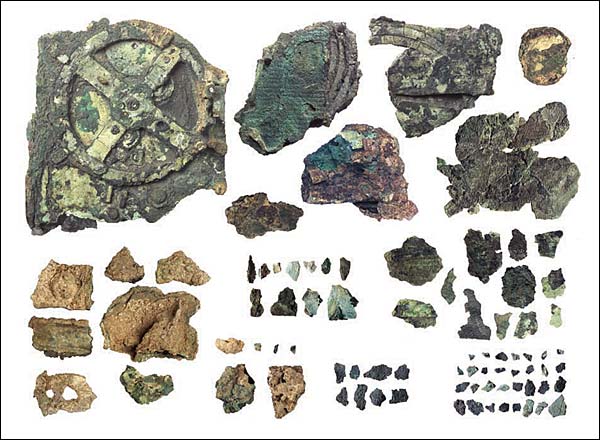
 A "punk" for the Classical cultures of Greece and Rome. It assumes that Archimedean types of inventions did not cease. Typical equipment include highly advanced catapults and siege machinery, balloons, primitive submarines, wooden equivalents of clockpunk, classical gear computers(like the one found called Antikythera mechanism, pictured above), primitive steam engines of Alexandria, bronze mirrors that redirect sunlight to burn ships... An interesting variations would be Egyptian sandalpunk, with optics and pyramid building tools; and Chinese sandalpunk which would consist of fireworks and junks. Bronzepunk and Ironpunk are variations of Sandalpunk.

Teslapunk
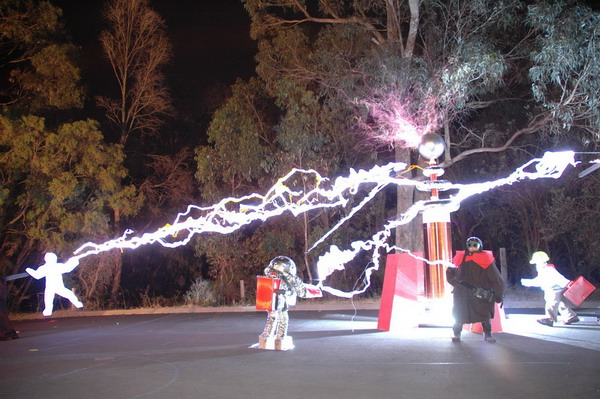
 Nikola Tesla was one of the most brilliant and unheard of scientist of his time. He envisioned a world of free energy and worldwide communication. Teslapunk incorporates his dream of death rays, Tesla coils, wireless communication, and antigravity devices into fiction.


Atompunk
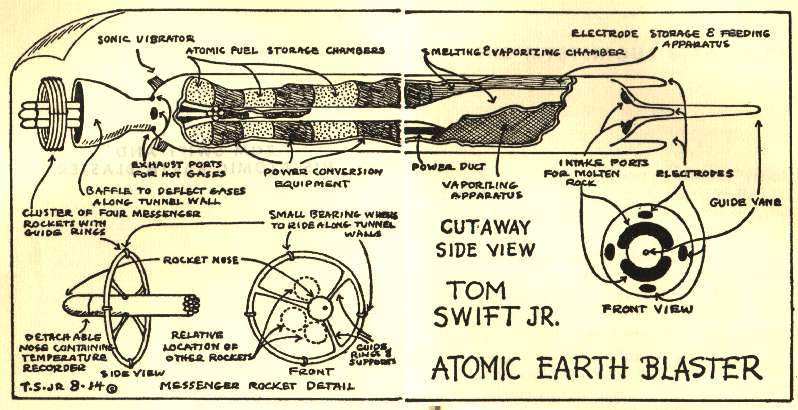
 The Atomic Age ushered by the 1940's. So in that tradition, everything or mostly everything in atompunk runs with nuclear energy. Radiation, nuclear warfare, mutations from such are the main problems in an atomicpunk story.


Dieselpunk
 The dependence on oil exaggerated is dieselpunk. A fantasy of the oil companies, it envisions all vehicles, equipment, and weaponry running in fossil fuels. (By the way, the computer shown is not running in oil, but is submerged in it to dissipate heat.)

Decopunk
 The chrome version of the future! In decopunk, the 1950's and 60's version of the future comes to fruition.

Biopunk
 What if genetic engineering has accomplished what our current technology did? A purely brain-based internet, organic transportation, psychic weaponry, a whole hosts of poisons, solar energy power from literal plants are some examples of biopunk. Pictured above is Mandark from the popular cartoon "Dexter's Laboratory", holding an organic/biopunk laser.

Nanopunk
 Nanotechnology is the emphasis for nanopunk. Nanobots, nanomaterials, nanomedicines... It is assumed nanobots make and maintain everything in a  nanopunk world.


Stonepunk
 Think of the technology used by the Flintstones. That is Stonepunk. The cavemen have cars and other modern equivalents using "Stone Age" technology. (Mind you, the author of the blog does not believe in a literal Stone Age, but believe humans were always advanced as a result of Creation, but he digresses.)

There's a few more "punks" that I felt was not invented, yet. And so I invented them:

Etherpunk 
 The ether theory of the nineteenth century is found to be true. In this universe, technology is mostly ether based. Ether seems to be the medium in which light transverses.

Crystalpunk
 Crystals hold piezoelectric properties. Thus, technology based solely on crystals are possible.

Chronopunk/Timepunk
 A techpunk relying on time travel. I don't exactly know how feasible that is, but it sounded cool.

Hydropunk/Waterpunk
 If cold fusion is ever feasible, it would change the world.


Aethericpunk
 A combination of Crystalpunk and Etherpunk. The (im)material that is Aether is understood to be partly spiritual, partly multidimensional, and barely matter-influenced. Also, it is the material that composes the time-space continuum. I use this for creating the fictional Mirror Universe.

Some other punks I didn't have time to write about...
Transistorpunk
Nowpunk
Splatterpunk
Elfpunk
Mythpunk


Thursday, March 8, 2012

AltHist: Eighteen Eighty Four: Rise of AmCap

The Federalist Alexander Hamilton's National Bank was deemed unConstitutional by a Republican controlled Supreme Court and is never brought to fruition. In the Jeffersonian era, the two Presidencies of James Madison and Andrew Jackson further limited what the national government was allowed to do, slowly turning the federal republic of the United States into a confederate republic. The Second Great Awakenings further strengthened the Protestant/Puritan work ethic and the free enterprise system of economy.
The War of 1811 against British-controlled Canada turned into a decade-long cold war. Frought with other military matters elsewhere in the world, particularly with Napoleon, the British Empire decides to sell Canada to the United States. This passes in the Senate, and the United States more than doubles its area in size. Canada is split into about ten territories for future statehood. Quebec's application for statehood is quickly accepted.
A Mexican War, made famous because of the defense in Alamo, gave the United States the whole of Mexico, divided into 5 territories and Texas, which are now states. There is talk of an "American Empire" in other parts of the world, especially in Europe.
The slave issue was relegated an issue of the state government by the federal government. The Union is preserved through political manuevering, though tensions are still high. However, Civil War was averted, and the North largely ignored the slavery in the South to avoid raising tensions. This show of power by individual states make some term the states "sovereignties", and sometimes "Sovereignties", to show that they now hold more sway over their areas than the national government and thus countries in their own right.
The reason for that the Civil War being averted is a force that has been gaining tremendous power in the North: the corporation. A result of advanced and unfettered capitalism, the North entered a state of technological advancement the world had never seen before. The South struggled in its dated agriculuturally-based economy. But the free enterprise system is not only limited in the North. Soon, entrepreneurs all over the South built corporations of the Industrial Age. The slave owners gradually lost power over time.
The aerocraft, a flying steam vehicle, was invented in 1854. It became a tool for exploration of the expansion. In 1860, electric generators now generated power to the growing Northern cities. In the South, each plantation came to have their own electric generator to operate machinery.
On April 15, 1865, because of the speeches of Lincoln, all Southern states abolished slavery, except as a method of criminal punishment. Slaves were no longer needed for the most part, efficient farming machinery operated by a one person became widespread. Steam tractors and plows multiplied the South's agricultural output. In turn, more and more of the populace began to dwell in the urban areas.
In 1867, Karl Marx publishes "Das Kapital". But he praises what Capitalism has done instead of degrading it, as in this timeline. He inspires a generation of radical entrepreneurs. Karl Marx dies a rich factory owner.
The more industrilized nation began expanding in three prongs: northwards to Canada, southwards to Mexico, and westward to the untamed wilderness. City building is rapid and accompanied by quick advances in technology. Needing a communications network between their polises, the corporations of the sovereignties built telegraph and the newly-invented telephone networks.
As the corporations grew in power, it was just logical that their power structures limit the governments. In 1878, the United States national government was incorporated(jokingly referred to as "U-dot-S-dot-A-dot-Inc" or "U.S.A.Inc"). It still functions as a intermediary between state governments, and the sovereignties maintained the power in their borders. The incorporated National Government is still the only power legally able to perform diplomatic relations with foreign nations, inter-state law enforcement, and since it is incorporated to make profits, no taxation. The government is now run by the citizens as they invest in it as any corporation.
The voting system is overhauled. All citizens can still vote for the House of Representatives and the electoral college for the President, however, the Senate is voted on by investing in government stock. The electoral college votes using the sovereignties investments and stock in the government for the President.
Afraid of the rapid technological change, the Neo-Luddite Party is formed. Initially, their main base of support are farmers. They prove to be unpopular in the long run as they turned radical. They are responsible for some terrorist acts.
By 1884, Europe is fraught into a war by pro-Capitalists and pro-Socialist groups.
In 1902, atmospheric space travel is invented.
(This alternate history is not finished.)