Showing posts with label time. Show all posts

Saturday, January 27, 2018

True Bible Reasons Why Church Is On Sunday Not Saturday


We go to church on Sunday, but the Jews held Sabbath on the last day. Why?

Often, people will use verses on Jesus being resurrected on the first day, or that the observance of Sabbath and days must be fully convinced in his own mind, but a deeper study of those actually either is incomplete or misguided.

And that is not even to say that the Jews didn't use the solar Gregorian calendar, but the Hebrew calendar which is based on the lunar cycle. Which means the last day of the week in the Hebrew calendar is not always Saturday, but could be Wednesday then Thursday the next month. At least according to Google.

The Sabbath. Is it on Saturday or Sunday?

People miss the point. It isn't about the Sabbath. Going to church isn't the Sabbath. They are two totally different things.

Nowhere does the Bible say that Sunday or the first day of the week has replaced the Sabbath, but that doesn't mean people are wrong in gathering to worship on the first day

But where does it say we are to meet in church for the Sabbath? Nowhere, either. The Sabbath is to be holy, yes, but people make a logical leap and assumption that means "go to church".

In fact, the first day and last day are both important and holy in the Bible.  They are both important today, as well. Those days are when schools are off, and many, if not most, jobs are off.

So before I lose you with this reasoning seemingly without a point, I will make this assertion so you know where I stand: Saturday is still the Sabbath and a day of rest, however, Sunday is the day of assembly primarily for New Testament believers.

Notice I didn't say worship. We must worship God every day.

Let me substantiate this claim Biblically.

What is the Sabbath?


Exodus 20:8-11
8 Remember the sabbath day, to keep it holy.
9 Six days shalt thou labour, and do all thy work:
10 But the seventh day is the sabbath of the Lord thy God: in it thou shalt not do any work, thou, nor thy son, nor thy daughter, thy manservant, nor thy maidservant, nor thy cattle, nor thy stranger that is within thy gates:
11 For in six days the Lord made heaven and earth, the sea, and all that in them is, and rested the seventh day: wherefore the Lord blessed the sabbath day, and hallowed it.


Where in these passages say that we are to gather together and worship on the Sabbath? Nowhere. To keep it holy, yes, but do not make the assumption and logic leap that "keeping it holy" is equal to "going to church". It may mean that, but not necessarily.

What it does say is that the Sabbath is mainly for rest, and it is in the seventh day.

Schools and many jobs have Saturdays off. It is already considered a day of rest.

So:
Sabbath = last/seventh day of the week
Sabbath = rest
Saturday = off day from school and/or work
rest = off day from school and/or work
Saturday = last/seventh day of the week
Sabbath = Saturday

But what about keep holy, then, if it doesn't mean go to church? Keeping it holy means keeping it apart as its own day. The word holy means "sanctified, or set apart". The passages explain it, six days man shall labor, and on the seventh, man will rest, making it a special day apart. It doesn't mean go to church.

Now, we have established that the Sabbath is the last day and is about rest. What about the first day?

The First Days In The Bible

The first mention we have of the first day is in Genesis 1, like we do about the last day. God uses the Creation week as the reason why the last day is the Sabbath. Without getting too convoluted, I would surmise it is obvious why the first day is on the surface important in the Creation week, for it being the beginning. It is also important because Jesus rose again on the first day. But that is just the shallow end of reasoning if we want to prove why we assemble on the first day and hence why we will just pass over those reasons, no pun intended.

We know in Acts that the disciples gathered on the first day.

Acts 20:7
7 And upon the first day of the week, when the disciples came together to break bread, Paul preached unto them, ready to depart on the morrow; and continued his speech until midnight.

Here we see clearly that the disciples came together on the first day.

Notice the phrase break bread. I believe this is referring to the communion (for obvious reasons). This will be important later on.

We also use this verse to justify all day meetings and also Sunday evening services, even if we don't always go till midnight.

Now, where does it say the first day replaced the Sabbath? Nowhere. Where does it say that the disciples gathering together means Sabbath? Nowhere. Where does it say preaching only happens in the Sabbath? Nowhere.

Now certain people would do some mental gymnastics and claim that since in Jewish time, days began in sunset or nightfall or whatever, and thus it was technically the last day, not the first day.

Which makes no sense because if they considered the first day as that time, it was the first day, and the day before the last day.

1 Corinthians 16:2
2 Upon the first day of the week let every one of you lay by him in store, as God hath prospered him, that there be no gatherings when I come.

Here we see a command to the church to lay in store on the first day of the week. We understand this to be tithes and offerings. Where do we see it commanded that we are to collect offerings on the Sabbath?

Even in the Old Testament do we even find the first day holy for worship in some contexts.

Nehemiah 8:2
And Ezra the priest brought the law before the congregation both of men and women, and all that could hear with understanding, upon the first day of the seventh month.

Nehemiah 8:18
Also day by day, from the first day unto the last day, he read in the book of the law of God. And they kept the feast seven days; and on the eighth day was a solemn assembly, according unto the manner.

These passages show it isn't out of the ordinary to hold services on the first day or any other day of the week, even if it went from first to last day. Notice, too, on the eighth day, which is the first day repeating again, a solemn assembly was held.

Exodus 12:16-17

16 And in the first day there shall be an holy convocation, and in the seventh day there shall be an holy convocation to you; no manner of work shall be done in them, save that which every man must eat, that only may be done of you.
17 And ye shall observe the feast of unleavened bread; for in this selfsame day have I brought your armies out of the land of Egypt: therefore shall ye observe this day in your generations by an ordinance for ever.

This is in the context of the Passover. So why is it relevant to the debate?

Jesus told us to observe the communion as oft as we will:


1 Corinthians 11:24-25
24 And when he had given thanks, he brake it, and said, Take, eat: this is my body, which is broken for you: this do in remembrance of me.
25 After the same manner also he took the cup, when he had supped, saying, this cup is the new testament in my blood: this do ye, as oft as ye drink it, in remembrance of me.

Remember breaking bread when the disciples were gathered together in Acts? They were observing the communion.

The communion is our equivalent Passover as Christ fulfilled the Passover. We have unleavened bread to remember Christ our Lord, hence we need to observe it on the first day as does the feast of Unleavened Bread, not the last day.

Notice it doesn't say that the Passover observance on the first day replaces the Sabbath last day, doesn't it?

Lastly, we are to assemble as much as we see the day approaching:


Hebrews 10:25
25 Not forsaking the assembling of ourselves together, as the manner of some is; but exhorting one another: and so much the more, as ye see the day approaching.

Now whether one chooses to assemble Saturday or Sunday or any other day of the week, we should assemble. And there's no Biblical law against assembling on Sunday. We should assemble more, in any day, not less. We have the liberty to.

So:
First day = Passover
Passover = communion
First day = disciples gathered + preaching
Disciples gathered = communion/Passover
First day = store tithes and offerings
Disciples gathered = assembling
Assembling + preaching + store tithes and offerings = go to church
Sunday = first day
Sunday = go to church

In Conclusion


We assemble with the church to worship God on Sunday
NOT because it is the Sabbath
NOT because it replaced the Sabbath
BUT
BECAUSE the disciples did so
BECAUSE it is commanded to store our tithes and offerings on the first day
BECAUSE the first day is still important even though it isn't the Sabbath
BECAUSE we are to observe communion as oft as we will, which is connected to the Passover, which happens in the first day of the week
BECAUSE we are to assemble any time as the day comes
HENCE
We may observe BOTH the last day of rest of Saturday and first day of assembly of Sunday.

Two weekend days sound nice, don't you think?


Monday, November 3, 2014

Short Story: Flattime

This, in essence, is supposed to allude to Flatland, except in explaining the many dimensions of time. This time elements in the story was inspired by a Facebook discussion, but the whole of it is a true story. The reference to the girls and a conference in the story was what prompted me to my fascination of time travel, and actually happened seven years ago. It is implied that the author believes them to be time travelers for some odd reason or another.
And I seriously did believe they were.

I can make things go backwards.

The steam from my coffee this morning coalesced back to its liquid.

That isn't supposed to happen. Steam goes up and scatters like all gases, not collect back to its source. Or at least gases that are not heavier than the earth's atmosphere.

I shake my head. It is rising out, not coalescing. Am I dreaming?

No, it isn't a dream. I pinch myself. My mind probably just wanted to rewind it. Maybe it's those memory supplements I've been taking? Is this almost video-like feedback the side effect?

Cool.

Huh, not really appear and disappear, it's more like rewinding time and remaining conscious. Interesting. Oh, my imaginations!

I saw three of them look at me interestingly. Three girls. They looked at me quizically. They looked eerily familiar and not familiar.

Even though they did not look out of place in this conference, they were striking. To me, at least.

Not attraction, no. A little bit of it, yes. Deja vu, perhaps? Probably rather my self-consciousness.

The feeling disturbed me enough to get out of my seat and go elsewhere.

The future is a the gravity of time.

You know how that if you jump, you fall back down? Gravity pulls us down to the Earth's core, unless impeded.

Time travel is like that. Even if you go backwards in time, once you arrive, time will automatically go forward.

Like gravity, the future affects those with more mass. We know at the speed of light, photons practically have no mass, and time is still for the photon.

So even though you can rewind to an extent, you will eventually have to go forward again.

The question is though, how do you jump?

Oh, everyone can rewind time and traverse through it. But only a few can remember, and even fewer, less than a handful, are conscious of doing so. Our memories, too, are held by time.

For example, if you rewound time for yourself, would you remember the future? Of course not, those memory of the future never existed, because they didn't happen for you to remember yet. Make sense?

Though, rarely, the imprint of energy is strong enough that they leave traces.

You know, dreams of days past? Of days never materializing? That is the trace of semi-conscious time travel. Most time travel is unconscious. Or rather, instantly forgotten as it rewinds.

After a couple hours wandering the conference, I chanced upon those three girls again. One of them asked me something. I think it was the blondish one.

I shrugged it off. I  muttered something about going to my friends. I don't know why I was feeling this way toward them. They're just girls. Of course, I have to impress them a little.

Yet, time, as we experience it is only a ray, not even a line. The ray points to the direction of the gravity. It is still only one dimensional, even if we go backwards.

But time also has more than one dimension, as space as three.

Some call it alternate universes. The branching universe theory. The reality, actually, is not made up of branches, but a width. If time is a line with length, it's width are the alternate choices we could have made at every given moment.

We too could traverse the width. Every choice we make, we could make. And we remember. And we see what could have been. Will I sip my coffee? Will I not? Will I have tea instead? That is the width of time in the moment.

You could see your reflection in this house of mirrors of yourself, making different choices. The farther you look at the horizon of time, the more radical and improbable your choice were. Width can be measured!

However, interestingly, the gravity of time affects our choices, and our choices in turn affect it. While we can ponder the choices we could have made, we are still dragged along the same ray, never completely getting out of the stream. Our free will is intact; not that we could change it, but it is we that made the change. We don't make all possible choices at the same time.

The rest of the day was inconsequential.

I left the conference a bit mellow. We boarded on a bus back to our school. I don't think I will see those girls ever again. Who are they? Why do they look so familiar?

What is the height of time, then? What is the third dimension of the temporality? Are we on a sort-of timesphere as humans are on a sphere called Earth in space?

Total alternate universes with different preconditions. A radically different time plane.

While the universe in the second dimension of time, more or less, have the same preconditions, the third does not.

This is the plane of stories. Universes with varying creation myths, alternate histories, revisionist histories, future histories of those histories, and whatnot. They all exist in the planes apart from this objective reality plane.
So if the future is the gravity of time, and if time is a sphere like Earth is in space, what is the core of this sphere? The end of time?

So if the drive to the future is the gravity of time, and time is like a sphere as Earth is a sphere in space, then what is the core of this timesphere? The end of time?

No.

God. Eternity.


Saturday, February 1, 2014

Why I Am Obsessed With Doctor Who: Parallels

People always ask me why I am obsessed with the phenomenon known as "Doctor Who".

They see my Matt Smith-esque bow tie and my sonic screwdriver. Well, one of three of them. Not including the sonic screwdriver app on my iPod. Which is in a TARDIS case. With a Police Box Lock Screen and TARDIS console Home Screen.

My Facebook and Instagram is littered with #DoctorWho posts. I make snide comments about "timey wimey" or other Doctor Who references in normal conversation, to the chagrin of others. I cried and squealed like a girl in watching the 50th anniversary special Day of the Doctor. I even cosplayed all the 13 main Doctors (including John Hurt) plus an alternate incarnations of the Doctor (the Valeyard )! I even started translating the KJV Holy Bible into Circular Gallifreyan.

I am obsessed. Why in the world(s)?

While some Whovians would say the Doctor's pacifism and cleverness, the emotional character stories, etc. got them, my obsession is a bit more personal. You need to know my personal history and interests pre-Who.

Before Doctor Who, I diagnosed myself with DID (Disassociative Identity Disorder), or more commonly known as MPD (Multiple Personality Disorder). I have counted about 12 alters in my fragmented personality, My MBTI personality testing usually comes up as INTJ (Introverted iNtuitive Thinking Judging), the personality type of applicable theorists and mastermind manipulators. I have been a sprinter throughout my high school, always running. My favorite colors have always been blue, white, and black.

Time travel and steam punk fascinated me to no end. I have written many a time travel theory and related subjects, even on this blog. I love British mannerisms and classics and gentleman dapper stylings and tea and accents. While I loved science fiction, Star Wars and other main staples did not have a great hold of my fleeting interests.

Early high school, I dressed in a leather coat as my vanity item. As high school progressed, I started wearing a small trench coat and suits. As I started college, I took to liking bow ties and top hats, instead of normal ties. I became the Prime Minister of a student leadership society.

Do you see why now? If you are a Whovian, you should have spotted the eerie similarities.

I only have gotten into Doctor Who last year (2013). Everything I mentioned above happened before 2013. I discovered that Doctor Who existed around 2011, but have not watched it until around late February of last year.

If you aren't a Whovian and do not get the similarity references, here there are:
1. The Doctor is only one man, but every time he is greatly injured or dying, he regenerates into a completely new Doctor, with new personality and look, and he has done so about 12 times. He also retains some personalities within his head, and also he meets his other selves while time traveling. But he's always the same Doctor.

In the same vein, with my disorder, I have 12 personalities (verified by a drawing I drew around 8th grade of my selves). Every time my heart breaks due to a very distressing emotional experience, an alter is created. I think it's my coping mechanism, but when that happens, my habits, mannerisms, and clothing changes to such a degree a new alter is born.

2. An MBTI chart show that most incarnations of the Doctor are of an INTJ type. The Doctor is known to be pulling strings and thinking of ways to cleverly outsmart his situation and opponents. My thinking process is more and less the same. Some of my personalities do show other variations of the MBTI.

3. A theme of the Doctor is running. I've always been running everywhere ever since middle school and throughout high school. So much so that people make snide comments about me doing so. But I can't help myself.

4. The TARDIS Police Box colors are blue, white, and black. My favorite colors before ever liking Doctor Who.

5. Time travel is central to Doctor Who if you haven't noticed yet. Steampunk and Victorian elements are present in Doctor Who. My favorite Doctor is the 8th, by the way, who has the best Victorian steampunk styled TARDIS interior. Earlier entries in my blog show my fascination with fringe science, techpunk, dimensions, alternate history, and time travel; all before I was ever obsessed.

6. Doctor Who is a British show, and has British things. I always have loved British stuff. The English I learned was British English, not American, growing up in the Philippines, before moving Stateside.

7. Doctor Who is science fiction. And I think it's the best so far.

8. The Ninth Doctor wore a leather coat. The Tenth wore trenchcoat and suits. The Eleventh wore bow ties and a top hat. Very creepily similar to my clothing changes and progression.

9. The title of Prime Minister holds more relation to the Doctor's archenemy the Master, not the Doctor himself. But it is a British thing. Also, back in 9th grade, I played the Prime Minister in Never Come Monday, a timey-wimey story about Monday never coming, meaning it was always Sunday.

So, in conclusion, Doctor Who fits my personality and history so much. I do not know why I have never found it before. It fits me perfectly. It parallels my life. And that's why I'm obsessed with Doctor Who.

Happy Anniversary to my obsession.

Notes:
I discovered that Doctor Who existed around 2011, but did not watch a single episode. I started watching Doctor Who around January/February 2013, but I did not grasp what the show was about and lost interest. It was rekindled when a friend of mine came to my house and we watched a couple more episodes, and I was hooked.

My middle school years were around 2005 to 2006. My junior high years were around 2007 to 2008. My high school years ranges from 2009 to 2012. The new Doctor Who started in 2005. My grade numbers and years coincided (2005 = 5th grade, 2006 = 6th grade, etc.) Everything I mentioned above unless otherwise noted happened before 2012.

Friday, September 14, 2012

InDev: Grandfather Paradox Part #2

"The Grandfather holds the watch to his gaze. Soon..."

Another blog post in developing Paradox, Grandfather. It is a casual time travel RTS game, or it probably can be more accurately called an RTT (Real Time Tactics) game.

Previously, I introduced the basic gameplay and the two main warring factions. But there is a special "faction", so to speak (Actually, two, if you count the neutral civilians as a faction). The Grandfather "faction" is the source of the blessings, or woes, of time travel in this world. It is composed of the Grandfather unit and his various incarnations. In 192X, he is a young man, who invented the time travel machine and set into motion the events culminating into the war between the Imperiarchy and Republicorp. In 195X, he is an old man, armed with a steampunk army of sorts.

The Grandfather "faction" only let's you play with one unit directly, the Grandfather. You can even control him with the WASD keys and shoot with the mouse button. He can enter any time machine. You have to avoid the Imperiarchy and Republicorp from killing you, or stealing your plans, or otherwise messing with history.

You can upgrade the Grandfather unit. He can be armed with a Chronogun that erases units from existence. When he is still, he is cloaked and invisible. His speed can also be upgraded. But he is weak constitutionally, so take care when manuevering into areas of heavy fire.

The Imperiarchy and Republicorp factions are with through five equivalent units each through four attributes. They are all infantry units. I did not want to add in vehicles and things to the lineup, although in another future version of the game, I might. Possibly the post-experiment version.

Now, I will explain the time travel system, more. In Skirmish battles, after winning, it saves the game, and you can load it, and play against yourself, as if trying to alter history. Or you can play as yourself, and finish in a lower time limit. The Campaign will work the same way. It will be interesting, or at least I hope so.

I decided to cut off the Campaign until the post-experiment version, which I might sell. The version for EGP will include only the Skirmish mode.

Saturday, September 1, 2012

InDev: Grandfather Paradox Part #1

"In 195X, two warring factions: the Imperiarchy and the Republicorp, are in a stalemate. Only one way to break this: time travel."

Paradox, Grandfather is a game I'm making for Experimental Gameplay: Time Manipulation for August and September. Details are subject to change. Note that the link provided for the download provides only a mockup prototype without gameplay, yet.

The game is set in an alternate past, where the Imperial States of Ohio (the Imperiarchy) and the United Sozist People's Republicorporation (the Republicorp) are embroiled in an apocalyptic Cold War in 195X. The weapon that caused this war is not the atom bomb, but the time machine.

The Imperiarchy decides to end the war by eliminating time travel in the past. The Republicorp travels back to prevent that alternation in history, then the Imperiarchy decides to stop the Republicorp from going... and so on.

The game is made to be a casual RTS, inspired by Relic of War and the Achron RTS. In the battlefield, the player is given two views. The first view shows 192X view of the battlefield. The second view is the present, or 195X, of the battlefield.


The factions must send units from 195X to 192X, but also can fight in 195X. Only in 192X can mission objectives be met. There is a Time Indicator in which the player can change so the player can send units any time in 192X. For example, if the Imperiarchy captures the "Grandfather"(revealed in a future InDev) in 192X, the Republicorp can rewind the Time Indicator and send troops to prevent his capture. Or the Republicorp can drag the time indicator and place troops in the future to stop the capture at the extraction point.

That is all for now! Gotta get back working. :)

Thursday, August 2, 2012

Mindwrap: Higher Dimensions

"I knew a man in Christ above fourteen years ago, (whether in the body, I cannot tell; or whether out of the body, I cannot tell: God knoweth;) such an one caught up to the third heaven. And I knew such a man, (whether in the body, or out of the body, I cannot tell: God knoweth;) How that he was caught up into paradise, and heard unspeakable words, which it is not lawful for a man to utter."
2 Corinthians 12:2-4


Ever since man had fallen into sin, humans have dreamed of realities higher than our bleak three-dimensional existence.

Is Heaven a higher dimension? Can the spirit world be explained as a dimension removed from our universe?

But before I go on, I will lay down the basics. As the video shows, a point has zero dimensions. A line will have one. A square has two. A cube has three. We live in a world with a visible three dimensions. Our universe also experiences the dimension of Time, but this blog post only concerns itself with spatial dimensions, not temporal.

Why can we not see or interact with other higher dimensions? We can draw an analogy from the book Flatland: A Romance of Many Dimensions. In Flatland, the inhabitants are only limited to 2 dimensions. The inhabitants are circles, squares, triangles, and so are their surroundings. A 3-dimensional entity can look down on the flat land, but the inhabitants cannot look up to the higher dimensional being, so to speak. To the inhabitants, the being is godlike.

This will imply that God is probably residing in the highest dimension conceivable, or outside all dimensions, yet interacting with the lowlier dimensions. This reflects His attributes of immanence and transcendence.

There have been theories that the spirit world is simply another dimension. One theory states that living people have a fourth-dimensional spirit attached to the three-dimensional body until death. An interesting concept. I don't know if it has truth behind it or not.

Now, the idea that Heaven(or even Hell) is another dimension, or a dimension within our universe has more credence. The Russian cosmonauts always bragged on the fact that when they went to space, they did not find God. They haven't looked at other dimensions!

Some say Heaven is in another planet somewhere. The Mormons and Jehovah Witnesses believe God as an alien being of sorts. Songs like this support that theory:

"Somewhere in outer space,
God has prepared a place
For those who Him and obey.
Jesus will come again,
Although we don't know when,
The countdown is getting lower every day!

Ten and Nine,
Eight and Seven,
Six and Five and Four,
Call upon the Saviour while you may.
Three and Two,
Coming through the clouds in bright array,
The countdown is getting lower every day!"

It's a fine Sunday School song, but possibly theologically incorrect. God is not a physical alien being from another planet in space. God is a Spirit. 

So, just some of my ranting, perhaps, but I hope it made you think.

Wednesday, May 23, 2012

Tech"punk"

Tech"punk" are the idea that speculates if a certain era and philosophy dominated technology and culture, and vice versa, producing anachronistic realities. The first things that comes into mind when talking about tech "punk" are steampunk and cyberpunk.

Types of Tech"punk":
Steampunk
 Steampunk is the idea that Victorian Age industry could have accomplished much of the technological results we see today and beyond using steam and conventional methods. For example, in steampunk, spacecraft, artificial intelligence, and other technological marvels today would have been built with just steam engines and conventional technology of gears and springs. Jules Verne is a source for many steampunk-like devices.

Cyberpunk
 What if the Internet connected everything and everyone? What if cybernetics were commonplace? This is the world that is cyberpunk. It typically is a near future world with robots, virtual reality, holograms, large corporations, and a currency of credits. Programs are advanced enough to be considered conscious. Movies like Tron and Robocop are cyberpunk.

Clockpunk
 A more primitive version of steampunk, "clockpunk", just uses springs and gears. So instead of using coal to power devices, pendulums are set, coils are tightened, and springs are compressed. While the much-touted Difference Engine, an ancestor of the computer, is usually considered steampunk, its gear-based nature places it as clockpunk. Leornardo Da Vinci's inventions are considered clockpunk. That being said, many people do not see a distinction between steampunk and clockpunk.

Sandalpunk/Bronzepunk/Ironpunk
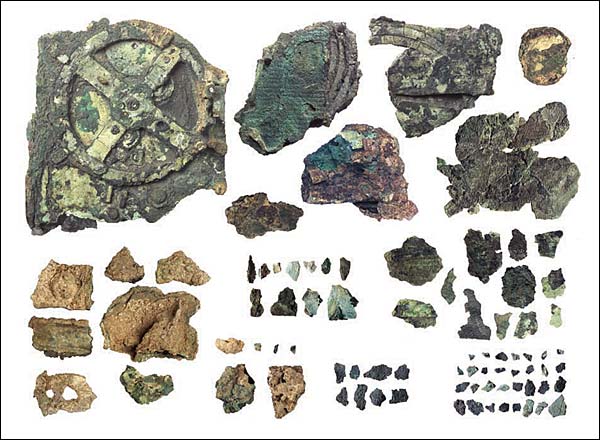
 A "punk" for the Classical cultures of Greece and Rome. It assumes that Archimedean types of inventions did not cease. Typical equipment include highly advanced catapults and siege machinery, balloons, primitive submarines, wooden equivalents of clockpunk, classical gear computers(like the one found called Antikythera mechanism, pictured above), primitive steam engines of Alexandria, bronze mirrors that redirect sunlight to burn ships... An interesting variations would be Egyptian sandalpunk, with optics and pyramid building tools; and Chinese sandalpunk which would consist of fireworks and junks. Bronzepunk and Ironpunk are variations of Sandalpunk.

Teslapunk
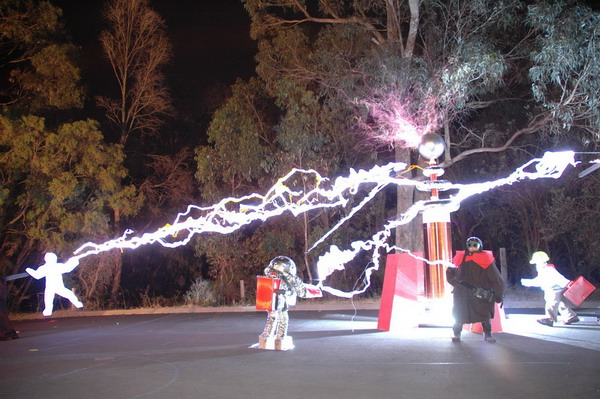
 Nikola Tesla was one of the most brilliant and unheard of scientist of his time. He envisioned a world of free energy and worldwide communication. Teslapunk incorporates his dream of death rays, Tesla coils, wireless communication, and antigravity devices into fiction.


Atompunk
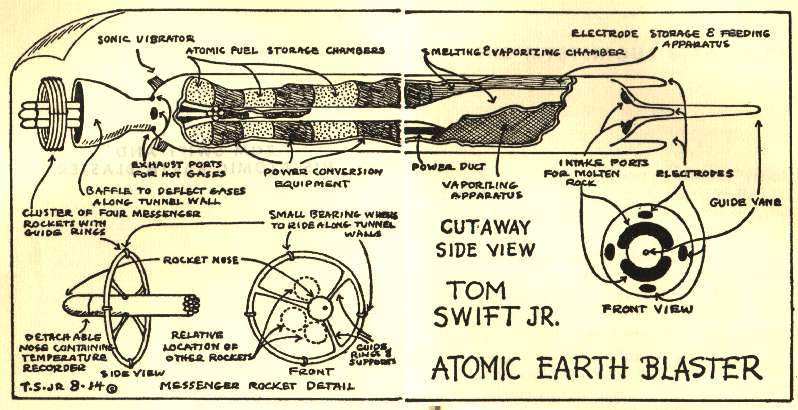
 The Atomic Age ushered by the 1940's. So in that tradition, everything or mostly everything in atompunk runs with nuclear energy. Radiation, nuclear warfare, mutations from such are the main problems in an atomicpunk story.


Dieselpunk
 The dependence on oil exaggerated is dieselpunk. A fantasy of the oil companies, it envisions all vehicles, equipment, and weaponry running in fossil fuels. (By the way, the computer shown is not running in oil, but is submerged in it to dissipate heat.)

Decopunk
 The chrome version of the future! In decopunk, the 1950's and 60's version of the future comes to fruition.

Biopunk
 What if genetic engineering has accomplished what our current technology did? A purely brain-based internet, organic transportation, psychic weaponry, a whole hosts of poisons, solar energy power from literal plants are some examples of biopunk. Pictured above is Mandark from the popular cartoon "Dexter's Laboratory", holding an organic/biopunk laser.

Nanopunk
 Nanotechnology is the emphasis for nanopunk. Nanobots, nanomaterials, nanomedicines... It is assumed nanobots make and maintain everything in a  nanopunk world.


Stonepunk
 Think of the technology used by the Flintstones. That is Stonepunk. The cavemen have cars and other modern equivalents using "Stone Age" technology. (Mind you, the author of the blog does not believe in a literal Stone Age, but believe humans were always advanced as a result of Creation, but he digresses.)

There's a few more "punks" that I felt was not invented, yet. And so I invented them:

Etherpunk 
 The ether theory of the nineteenth century is found to be true. In this universe, technology is mostly ether based. Ether seems to be the medium in which light transverses.

Crystalpunk
 Crystals hold piezoelectric properties. Thus, technology based solely on crystals are possible.

Chronopunk/Timepunk
 A techpunk relying on time travel. I don't exactly know how feasible that is, but it sounded cool.

Hydropunk/Waterpunk
 If cold fusion is ever feasible, it would change the world.


Aethericpunk
 A combination of Crystalpunk and Etherpunk. The (im)material that is Aether is understood to be partly spiritual, partly multidimensional, and barely matter-influenced. Also, it is the material that composes the time-space continuum. I use this for creating the fictional Mirror Universe.

Some other punks I didn't have time to write about...
Transistorpunk
Nowpunk
Splatterpunk
Elfpunk
Mythpunk


Tuesday, May 22, 2012

Mindwrap: Time Travel

"Redeeming the time, because the days are evil." Ephesians 5:16

Man has dreamed of time travel throughout the centuries. The chance of changing the past or manipulating the future has haunted many. But is it possible?

Science postulates that it is possible by using wormholes(a spinning black hole) and sending a space ship through it. We may go to the past by exceeding the speed of light. But the problems with this are obvious. We do not have the technology to accomplish such feats.

Some are in favor of "time traveling" with the mind. The advantages of this is obvious. First, one would not be affected physically by any constraints. Secondly, time itself will not be affected, since it is an observation without any influence on the Time stream. This may be called "prophesying" or "divination". However, the Bible explicitly bans any form of "divination", since it is a demonic form of mental time travel. Prophecy has already ceased for the Church (I Cor. 13).

We know that God is an Infinite and Eternal Being. He created Time itself. As you know, Time is a dimension. Space is composed of three dimensions of width, height, and depth, however, Time seems to be only comprised of one(or two, depending on your perspective). Does Time have more than one dimension that we can't access but only God can?

I find it useful to think of Time as a line, and Eternity as a sea around that line. The sea of Eternity is three-dimensional, while Time is one-dimensional. God can see all of Eternity at once, as if the past and future doesn't exist, as if everything happens at once to God in His Eternal Present. God, however, in His human form, our Lord Jesus Christ, limited Himself to our Time "line".

In the Bible, it records that the prophets had special insight from God concerning the past and the future. Moses recorded a Creation that he did not witness, and the other prophets like Daniel and Isaiah saw the future of the nation of Israel.

There is one person in the Bible that seems to have traveled in the future, physically. Even farther than our own future right now(in the time of this writing). That person is the Apostle John. In Revelation, it is recorded in the first chapter, tenth verse: "I was in the Spirit on the Lord's day, and heard behind me a great voice, as of a trumpet,"


The Lord's day is a reference to the Rapture. The Rapture hasn't happened yet.


Some may say that John was actually in a trance. But if you may recall, in Acts, Phillip the apostle was too transported physically by the Spirit. It is akin to teleportation.


Acts 8:39: "And when they were come up out of the water, the Spirit of the Lord caught away Philip, that the eunuch saw him no more: and he went on his way rejoicing." 


The answer is, time travel is possible... if only God transported you Himself by His will. We cannot alter the past, or rectify the present by going to the future. But who needs tine travel when the Bible already records the past, present, and the future of the universe and beyond?

Grandfather Paradox