Showing posts with label science. Show all posts

Saturday, May 3, 2014

MindWrap: Why Are Humans Afraid Of An Artificial Intelligence Rebellion?

I'm still grieving today from the Tittle's loss, but due to a couple recent articles in the news about a subject I've always wanted to touch, I will analyze this question, "Why are humans afraid of rebellion from super artificial intelligence?". Movies like the Terminator and Matrix popularize the idea: that man will be ruled by machines.

The Butlerian Jihad, a fictional artificial intelligence uprising in the Dune series


On May the 1st, "Mayday", Stephen Hawking, the acclaimed thinker, warned us about the implications of highly advanced artificial intelligence and it's possible threat to humanity. To him, we aren't taking artificial intelligence seriously enough.

One can imagine such technology outsmarting financial markets, out-inventing human researchers, out-manipulating human leaders, and developing weapons we cannot even understand. Whereas the short-term impact of AI depends on who controls it, the long-term impact depends on whether it can be controlled at all. ~ Stephen Hawking

Today, an article comes out on Neurogrid, a chip that is modeled after the human brain's parallel processing power. While not specialized as traditional supercomputers in that it can run purely mathematical computations, Neurogrid is important step in that in reflects brain activity as is understood.

But the fundamental difference between the way traditional computing systems model the brain and the way Neurogrid works lies in the way the computations are performed and communicated throughout the system.
Most computers, including supercomputers, rely on digital signaling, meaning the computer carries out instructions by essentially answering "true" or "false" to a series of questions. This is similar to how neurons communicate: they either fire an action potential, or they don't.

Indeed, interesting technology. It does seem we are headed to some kind of singularity, but not one imagined by transhumanists in my opinion. But I digress. We come back to the original question. Why are humans afraid of a revolt by computerized beings?

As a Christian, I believe that the created are no greater than the creator(s), and there is no evolutionary process that creates something greater than itself, though I believe there are only at best, horizontal changes, not anything significant vertically upwards. I also believe the Bible is literal and completely true.

With those assumptions, my argument is simple. Humanity remembers his rebellion against God in Eden, and we fear our creations will do that to us.

In Genesis, God, a Superintelligence far beyond comprehension, creates intelligences according to His image: Adam and Eve. They were not greater than their Creator. And yet in their desire to become like God, they fell.

In our remembrance, we falsely think that mere computers will become self-aware. Unfortunately, self-awareness is only available through spiritual means. Even animals are not self-aware but are ruled by instinct.

And the LORD God formed man of the dust of the ground, and breathed into his nostrils the breath of life; and man became a living soul. Genesis 2:7

I subscribe to Dr. Caroline Leaf, a cognitive neuroscientist, in regards to the mind and brain. Only the spirit can bring self-awareness. No amount of software programming or advancement in hardware will create something greater. Yes, computers are very specialized and efficient in what they can do, whether or not be it mathematical computation or chess, but it will only be mere reflections and only statistical advantage, not a qualitative one.

In our primal memories and fears and sinful nature, we create the robotic Skynet boogeyman. We fear that computers will be corrupt because we are corrupt.

And that is true to an extent. It would make sense that everything we make is fallen. Humans might program or manufacture devices to have evil purposes. But machines will never be inherently sinful or purposely, self-awarely corrupt, because they will be at best, tools, not life.

Though maybe the statue of the Beast in Revelation may be an exception. Who knows? It's possible that demonic presence or counterfeit intelligence may manifest itself.

And he had power to give life unto the image of the beast, that the image of the beast should both speak, and cause that as many as would not worship the image of the beast should be killed. Revelation 13:15

Monday, August 5, 2013

Mindwrap: The Gutenberg Future

This is a thought experiment on the future of 3D printing and its impact. I would have classified it as AltHist, but it concerned more of our immediate and long term future.

This is the world of the Gutenberg Future.

Background:
The method of 3D printing, once the economical and technological hurdles will be overcome, represents the greatest potential of revolution for years to come. From Gutenberg, we have the printing press and the power of words... and thus with the portable, cheap 3D printer, we have the power of creating objects.

Economy:
The most obvious impact will be on the economy. Stores will become increasingly useless as consumers learn to simply print whatever object they want to acquire. Plastic objects are the most prolific, but printing of metals, food material, etc. appear as science advances. The 3D printers become cheaper, more portable,  and more complex, along with computational power as with Moore's law, allowing for more complicated 3D objects. Common and mainstream brand names become less important, while specialty brand names do.

Education:
More classes will be devoted to 3D modeling and printing. It may start in existing art classes of schools and integrated in the curriculum of technical schools, then every school will soon have a specialized course or class dedicated to 3D modeling and printing.

Food:
The printing of food will start in gourmet kitchens and specialty chefs. If personal gardening (and even meat creation) is not made easy enough with the genetic and bio tech advancements, farms and markets for fresh produce and meats will still exist.

Culture:
Those who don't have 3D printing technology are at a great disadvantage, however, a sub-culture rises, somewhat reminiscing the hipster movement of the early 21st century that harkens back into antiquated styles.

Arts:
Those who expert modelers in 3D programs will become more commonplace, and their skills are important in the jobs market. Craftsmanship of the hands will still exists. Wood and stone creations will still enjoy popularity as art, symbolizing hard work and toil, especially for the rich. Clothes will still be manufactured by factories unless their is a technological leap in creating soft fibers. Once 3D printing or nanotechnology replicates wood and stone, those are seen as inferior.

Government:
The rise of the corporation and their scholarly offspring, the mathematician numecrats ("those that rule with numbers", also, numerati, as coined by Stephen Baker) create new government paradigms: the corpocracy and numecracy. There are more independent local regions.

Beyond Gutenberg:
Nanotechnology may be utilized and create Star Trek-like replicators. However, resources are still needed; there needs be some raw material and energy for nanobots to work on.

Sunday, June 9, 2013

Fanfiction: Jack And The Magic Bean

Read Jack And The Magic Bean by Karthey M

This fanfiction story about a Doctor Who/Stargate crossover is short but sweet. Composed of six chapters, it details the meeting of Jack O'Neill and the Doctor in what looks like to be a planet with original alien lifeforms, the Arnak.

Apparently, the Doctor is a Tollan ambassador, or rather, Earth's ambassador to the Tollans. I do think the latter is the case, but if the its the former it would be unclear what the relation of the Tollans, a Stargate civilization, is to Gallifrey, the planet where the Doctor hails. If parallels can be made, the Gallifreyan civlization is very similar to the Tollan civilization. One, they are both ancient and possess more advanced technology than the other races. Two, they both are isolationist, enigmatic, and arrogant. I'd imagine though that the Ancients have more in common with the Gallifreyan Time Lords.

The relationship of the Doctor to the American SG-1 is also a bit unclear, knowing that the Doctor also worked for the global UNIT in various circumstances, but enough about the ambiguities.

The author (whom I've known for quite some time and she can be a bit stubborn ;) presents the Doctor's eccentricities rather efficiently and accurately. I would think however that his conversational-style that he uses on the story does not always match up to Matt Smith's acting on the TV show. To be fair, the author manages to capture the fast-paced tone of the conversations.

The Doctor's companions, the Ponds, could've used a bit more character development. They hardly interact with the other characters, and somewhat seems to be there simply to explain what the Doctor is all about to the SG-1 team and to ask questions about Stargatey stuff in return.

I do think Stargate was more presented better than the Doctor Who part. The mannerisms of the Stargate characters were what I expect from the TV show.

The alien lifeforms, Arnak, are described as humanoid giants. Knowing both shows' obsessions of seeding humans around the galaxies with genetic anomaly, it shouldn't be a surprised. The threat of the Arnak dominating Earth and enslaving is not as compelling as I'd like. My sense of belief was shattered when a giant goose is introduced in the story. I know it was supposed to be like the story, and Doctor Who usually has a ridiculous animal aliens sometimes, but it just didn't fit, I think.

The story is supposed to be the origin of Jack and the Magic Bean legend on Earth. The best I can summarize the story without spoiling it for you ("Spoilers!"). Anyways, it was a fun read, but with a bit of tweaking and research, it would be a bit more enthralling. But excellent job, Karthey! :D

Friday, September 14, 2012

InDev: Grandfather Paradox Part #2

"The Grandfather holds the watch to his gaze. Soon..."

Another blog post in developing Paradox, Grandfather. It is a casual time travel RTS game, or it probably can be more accurately called an RTT (Real Time Tactics) game.

Previously, I introduced the basic gameplay and the two main warring factions. But there is a special "faction", so to speak (Actually, two, if you count the neutral civilians as a faction). The Grandfather "faction" is the source of the blessings, or woes, of time travel in this world. It is composed of the Grandfather unit and his various incarnations. In 192X, he is a young man, who invented the time travel machine and set into motion the events culminating into the war between the Imperiarchy and Republicorp. In 195X, he is an old man, armed with a steampunk army of sorts.

The Grandfather "faction" only let's you play with one unit directly, the Grandfather. You can even control him with the WASD keys and shoot with the mouse button. He can enter any time machine. You have to avoid the Imperiarchy and Republicorp from killing you, or stealing your plans, or otherwise messing with history.

You can upgrade the Grandfather unit. He can be armed with a Chronogun that erases units from existence. When he is still, he is cloaked and invisible. His speed can also be upgraded. But he is weak constitutionally, so take care when manuevering into areas of heavy fire.

The Imperiarchy and Republicorp factions are with through five equivalent units each through four attributes. They are all infantry units. I did not want to add in vehicles and things to the lineup, although in another future version of the game, I might. Possibly the post-experiment version.

Now, I will explain the time travel system, more. In Skirmish battles, after winning, it saves the game, and you can load it, and play against yourself, as if trying to alter history. Or you can play as yourself, and finish in a lower time limit. The Campaign will work the same way. It will be interesting, or at least I hope so.

I decided to cut off the Campaign until the post-experiment version, which I might sell. The version for EGP will include only the Skirmish mode.

Wednesday, May 23, 2012

Tech"punk"

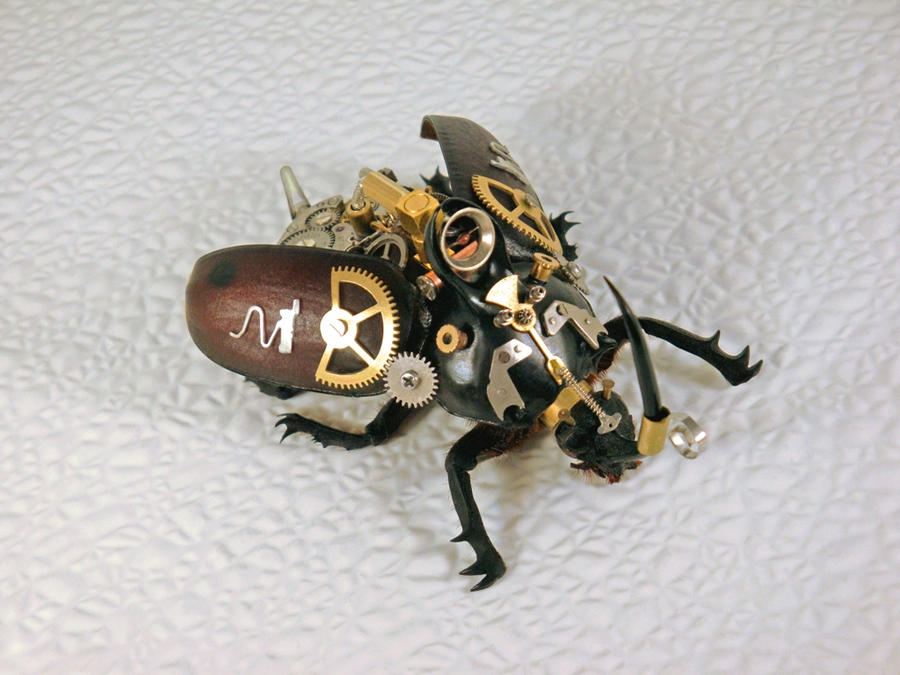
Tech"punk" are the idea that speculates if a certain era and philosophy dominated technology and culture, and vice versa, producing anachronistic realities. The first things that comes into mind when talking about tech "punk" are steampunk and cyberpunk.

Types of Tech"punk":
Steampunk
 Steampunk is the idea that Victorian Age industry could have accomplished much of the technological results we see today and beyond using steam and conventional methods. For example, in steampunk, spacecraft, artificial intelligence, and other technological marvels today would have been built with just steam engines and conventional technology of gears and springs. Jules Verne is a source for many steampunk-like devices.

Cyberpunk
 What if the Internet connected everything and everyone? What if cybernetics were commonplace? This is the world that is cyberpunk. It typically is a near future world with robots, virtual reality, holograms, large corporations, and a currency of credits. Programs are advanced enough to be considered conscious. Movies like Tron and Robocop are cyberpunk.

Clockpunk
 A more primitive version of steampunk, "clockpunk", just uses springs and gears. So instead of using coal to power devices, pendulums are set, coils are tightened, and springs are compressed. While the much-touted Difference Engine, an ancestor of the computer, is usually considered steampunk, its gear-based nature places it as clockpunk. Leornardo Da Vinci's inventions are considered clockpunk. That being said, many people do not see a distinction between steampunk and clockpunk.

Sandalpunk/Bronzepunk/Ironpunk
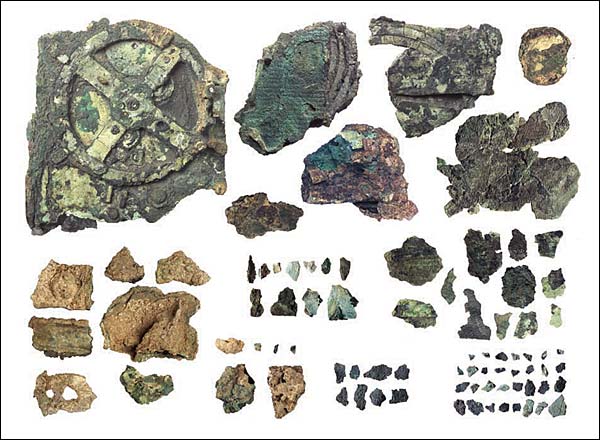
 A "punk" for the Classical cultures of Greece and Rome. It assumes that Archimedean types of inventions did not cease. Typical equipment include highly advanced catapults and siege machinery, balloons, primitive submarines, wooden equivalents of clockpunk, classical gear computers(like the one found called Antikythera mechanism, pictured above), primitive steam engines of Alexandria, bronze mirrors that redirect sunlight to burn ships... An interesting variations would be Egyptian sandalpunk, with optics and pyramid building tools; and Chinese sandalpunk which would consist of fireworks and junks. Bronzepunk and Ironpunk are variations of Sandalpunk.

Teslapunk
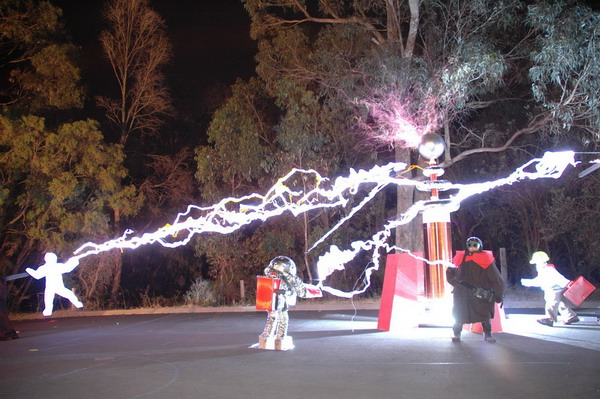
 Nikola Tesla was one of the most brilliant and unheard of scientist of his time. He envisioned a world of free energy and worldwide communication. Teslapunk incorporates his dream of death rays, Tesla coils, wireless communication, and antigravity devices into fiction.


Atompunk
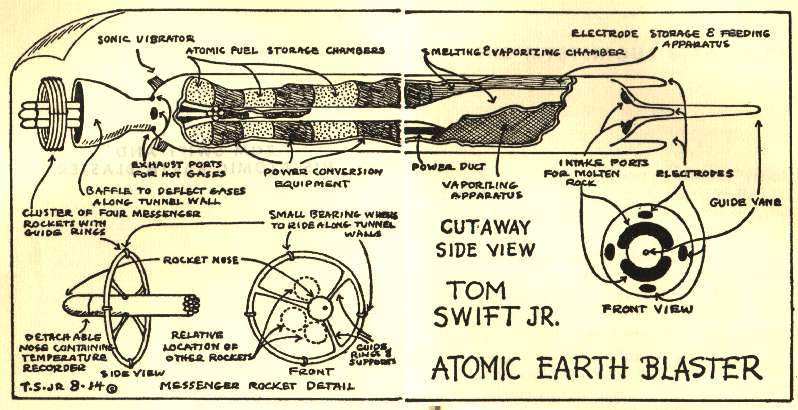
 The Atomic Age ushered by the 1940's. So in that tradition, everything or mostly everything in atompunk runs with nuclear energy. Radiation, nuclear warfare, mutations from such are the main problems in an atomicpunk story.


Dieselpunk
 The dependence on oil exaggerated is dieselpunk. A fantasy of the oil companies, it envisions all vehicles, equipment, and weaponry running in fossil fuels. (By the way, the computer shown is not running in oil, but is submerged in it to dissipate heat.)

Decopunk
 The chrome version of the future! In decopunk, the 1950's and 60's version of the future comes to fruition.

Biopunk
 What if genetic engineering has accomplished what our current technology did? A purely brain-based internet, organic transportation, psychic weaponry, a whole hosts of poisons, solar energy power from literal plants are some examples of biopunk. Pictured above is Mandark from the popular cartoon "Dexter's Laboratory", holding an organic/biopunk laser.

Nanopunk
 Nanotechnology is the emphasis for nanopunk. Nanobots, nanomaterials, nanomedicines... It is assumed nanobots make and maintain everything in a  nanopunk world.


Stonepunk
 Think of the technology used by the Flintstones. That is Stonepunk. The cavemen have cars and other modern equivalents using "Stone Age" technology. (Mind you, the author of the blog does not believe in a literal Stone Age, but believe humans were always advanced as a result of Creation, but he digresses.)

There's a few more "punks" that I felt was not invented, yet. And so I invented them:

Etherpunk 
 The ether theory of the nineteenth century is found to be true. In this universe, technology is mostly ether based. Ether seems to be the medium in which light transverses.

Crystalpunk
 Crystals hold piezoelectric properties. Thus, technology based solely on crystals are possible.

Chronopunk/Timepunk
 A techpunk relying on time travel. I don't exactly know how feasible that is, but it sounded cool.

Hydropunk/Waterpunk
 If cold fusion is ever feasible, it would change the world.


Aethericpunk
 A combination of Crystalpunk and Etherpunk. The (im)material that is Aether is understood to be partly spiritual, partly multidimensional, and barely matter-influenced. Also, it is the material that composes the time-space continuum. I use this for creating the fictional Mirror Universe.

Some other punks I didn't have time to write about...
Transistorpunk
Nowpunk
Splatterpunk
Elfpunk
Mythpunk